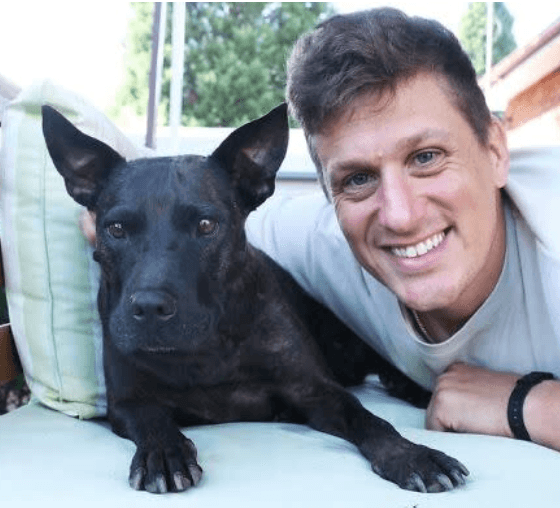
Before
My dog, Rosie, was diagnosed with terminal cancer.
One of the tumors on her leg was about the size of a tennis ball. It was aggressive, and the outlook wasn’t good.
I threw everything at it. Chemotherapy and surgery slowed things down, but they didn’t shrink the tumors.
I’m a data scientist, not a doctor. I don’t know medicine, but I do know data and AI. I focused on helping Rosie using the tools I had. I found myself going deeper into the problem and trying to understand what was actually happening.
I wasn’t ready to accept that there was nothing left to try.
What changed
At some point, I stopped thinking about the tumor as something to remove and started thinking about it differently.
This thing was a goldmine of information about what was actually wrong.
Instead of discarding it, I treated it as data.
The first step was finding a lab that could sequence the tumor. The idea is to compare healthy DNA with tumor DNA and identify exactly where the mutations have occurred. Once I had that data, I used AI to help me understand what I was looking at and what might be possible.
AI also helped me figure out which experts to talk to and what questions to ask them. It helped me get to the right people faster and make better use of those conversations.
Every time I went back to experts, I came prepared. I did the work, brought results, and kept pushing forward.
I asked questions, got answers, and kept going one layer at a time until I could connect the pieces.
At one point, we identified a potential drug, but the company refused to provide it. That was a tough moment. It felt like the wind went out of my sails.
But that led to another path.
Eventually, that led to designing a one-off, personalized mRNA cancer vaccine based on Rosie’s specific tumor.
AI also helped me identify a partner that could actually manufacture it.
Outcome
We administered the vaccine.
The entire tumor system on her leg was more or less deleted.
One tumor did not respond. When I looked closer, it turned out to have different mutations.
That changed how I thought about the problem again.
This second tumor was another source of information. It showed that different cancers inside the same dog could require different solutions.
So I designed a second version of the vaccine based on that tumor.
The first vaccine took about three months to develop. The second took one month. The most recent version was completed just days ago.
From diagnosis to where we are now, this has been a multi-month process. It was not one breakthrough moment. It was a series of steps that kept building on each other.
A few weeks after treatment, Rosie was back at the dog park chasing a rabbit and jumping fences. That was the moment it really hit me.
I still think about what would have happened if I had not asked one more question for Rosie.
Explore this story
- Forbes Article. He Solved His Dog’s Cancer: Three AI Models Helped
www.forbes.com/sites/johnwerner/2026/04/05/he-solved-his-dogs-cancer-three-ai-models-helped/
- How I created Rosie's mRNA Vaccine Protocol
x.com/paul_conyngham/status/2036940410363535823
- Meet the man who designed a cancer vaccine for his dog
news.unsw.edu.au/en/meet-the-man-who-designed-a-cancer-vaccine-for-his-dog
What made this possible
1. Sequence the tumor - Compare healthy DNA vs tumor DNA to identify mutations - Work with a sequencing lab to generate the data
2. Analyze mutation data - Use ChatGPT, Gemini and Grok to interpret results - Use AlphaSense to find and connect relevant research
3. Map mutations to targets - Identify mutated proteins that could be targeted - Translate mutation data into actionable insights
4. Design a personalized mRNA vaccine - Create a one-off vaccine based on the tumor’s mutations
5. Manufacture the treatment - Find a partner lab capable of producing the vaccine
6. Administer and monitor - Deliver the vaccine and track tumor response
7. Iterate based on results - Re-sequence non-responsive tumors - Design a second version targeting different mutations
8. Improve speed over time - First version: ~3 months - Second version: ~1 month - Future versions: potentially weeks
The process was iterative. Each answer led to a better question.
I did not follow a predefined path. I kept refining my understanding until I could act.
Enjoyed this story?
Discover another real way people are using AI.

AI saved my creative spark as a designer
A product designer used AI tools like Cursor to transform their designs into dynamic, buildable projects
Read next story