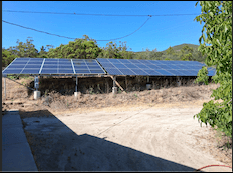
Before
I'm 72 years old and live on an off-grid homestead. After 20 years in the Navy and more than two decades running maintenance at a youth camp, I was comfortable solving problems. But the solar system, batteries, irrigation, orchard, garden, and small jam-and-jelly business that keep this property running often required expertise I simply didn't have.
Before AI, I was running much of it on instinct, guesswork, and whatever information I could dig up online. When something went wrong, I often knew there was a problem, but not where to start.
The biggest challenge was my solar and battery system. It is a 12kw Schneider setup with over 500 settings that can be configured. I'm not an electrician, and it is not something you just "figure out" by poking around.
Before AI, I would have either lived with the problems, paid someone a lot of money to come out here if I could even find someone willing, or spent weeks researching things I didn't even have the vocabulary to describe.
Even when I tried to learn on my own, I often didn't know the right terms to search for or the right questions to ask.
Most likely, I would have ended up with a system that never ran at its full potential.
On an off-grid property, that kind of expertise doesn't exist unless you want to spend a fortune or wait weeks.
What changed
I started using Microsoft Copilot as a way to think through problems I couldn't easily solve on my own.
What AI really did was give me access to the kind of expertise that normally would take a whole crew of different trades to cover.
When my generator would not qualify on my inverters, it helped me understand the wiring logic and settings so I could narrow down the cause.
When my battery banks showed strange readings, it helped me interpret the numbers and compare them to expected behavior.
When I needed to plan irrigation, identify disease and pest problems in the orchard, formulate recipes for my jam and jelly business, or troubleshoot equipment, it helped me work through the problem step by step.
The biggest example was the solar system.
Between a neighbor and AI, I was able to dial it in to the point where I now cover all the loads on the property and even sell power back to the utility company.
AI didn't magically fix things for me.
It helped me understand what I was looking at.
And that made all the difference.
Outcome
The biggest change is not that I learned more about solar systems.
It's that I became capable of taking on problems I never would have attempted before.
A good example was a failing VoIP phone system.
Before AI, I never would have attempted something like that. I would have assumed it was a job for somebody else.
Instead, I went from being completely lost to troubleshooting the problem, navigating two different provider portals, understanding what was wrong, and eventually setting up an entirely new system from scratch.
That is something I never would have attempted on my own.
The same is true across the property.
AI has helped me diagnose issues, understand equipment, improve systems, and make decisions with confidence instead of guesswork.
The solar and battery system alone probably saved me thousands of dollars in electrician visits, while giving me a level of understanding I would not have gained otherwise.
What people don't see is that these are not "tech problems."
They are real-life problems that affect whether I can run my home, communicate, manage my systems, and keep things working.
At 72 years old, AI has made it possible for me to learn things I never thought I could learn.
It hasn't turned me into a technician.
But it has given me the confidence—and the ability—to take on things I would have avoided or paid someone else to handle.
That's a bigger change than I ever expected.
How to try this yourself
Step 1: Describe the problem in as much detail as possible
Include symptoms, measurements, settings, photos, specifications, and anything unusual you have observed.
Step 2: Ask AI to help narrow down possible causes
For example:
"My generator will not qualify on my inverter. Here are the settings, wiring details, and error messages. What should I check first?"
Step 3: Use AI to understand the system, not just get an answer
Ask why something is happening and what normal behavior should look like.
Step 4: Compare real-world measurements against expected behavior
Use actual readings, temperatures, voltages, or other data to refine the diagnosis.
Step 5: Work through solutions one step at a time before making changes
Enjoyed this story?
Discover another real way people are using AI.

AI saved my ability to hold complex projects together
A man with ADHD used AI to create cognitive scaffolding to track his projects and life
Read next story